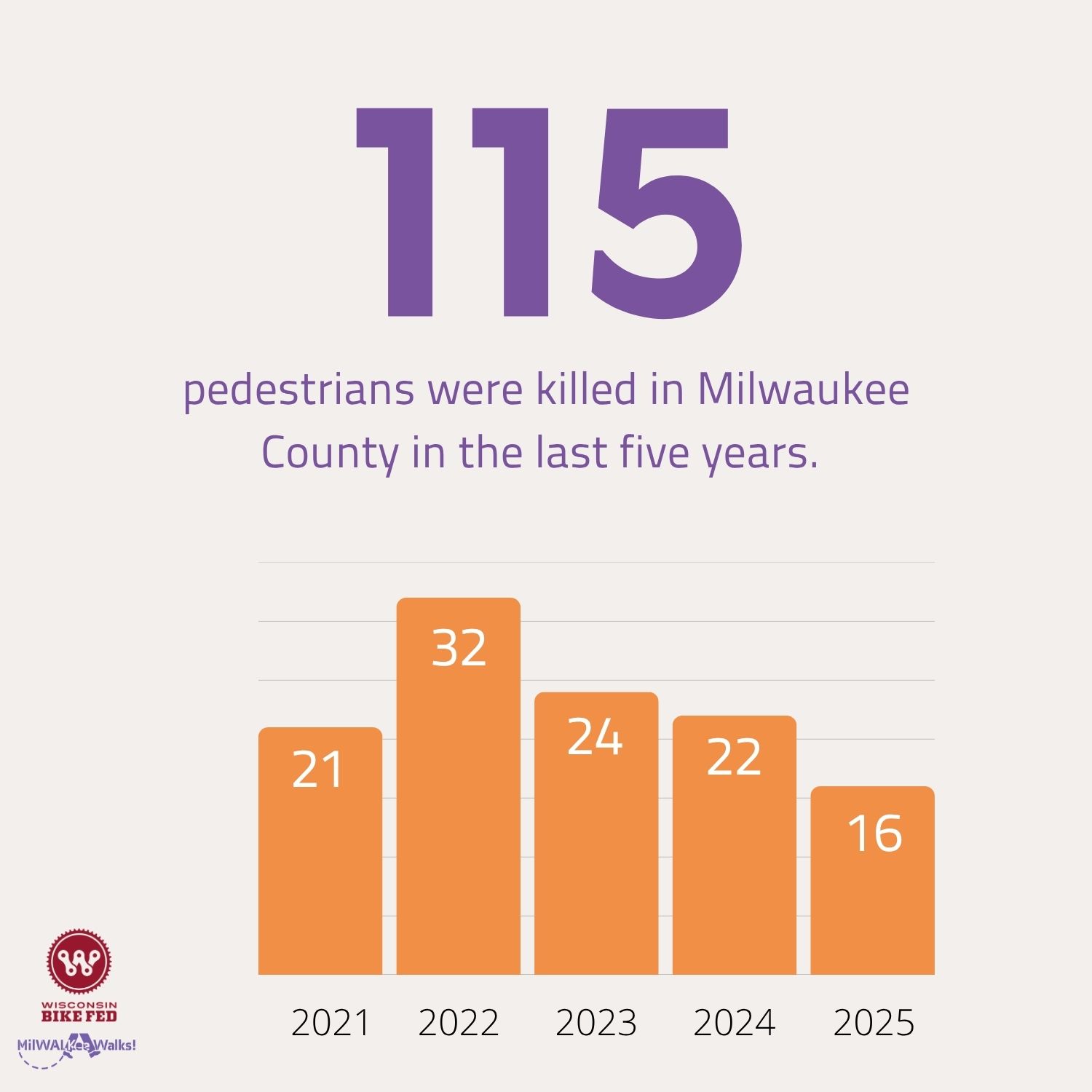
In 2025, Milwaukee County had the lowest number of pedestrian fatalities since our record high in 2022. While 32 pedestrians died of fatal injuries in 2022, that number has steadily decreased every subsequent year.
However, 16 pedestrians dying of motor vehicle crashes in 2025 is simply too many human lives lost. The only acceptable number of pedestrian deaths and life-altering injuries is ZERO.
For years, traffic crashes have been inaccurately referred to as “accidents”. The word “accident” suggests that nothing could have been done to prevent the incident – it was simply a random occurrence or a product of chance. “Accident” implies that solutions to traffic violence are unknowable or do not exist. In recent years, there has been an intentional shift among transportation specialists, government officials, journalists, and more to replace the word “accident” with “crash” or “collision”.
Since we can identify the causes of crashes, we can take action to alter the effect and avoid collisions. These are not Acts of God but predictable results of the laws of physics.
Federal Motor Carrier Safety Administration
A review of the pedestrian crash data and police reports from the 16 fatal crashes in 2025 fail to reveal a single culprit for the continued pedestrian safety crisis in Milwaukee County. To say that all pedestrian crashes are a result of reckless driving, poor street design, or inattentive pedestrians would be an oversimplification. A variety of factors contribute to these tragic outcomes, so a variety of solutions are needed to create safer circumstances for pedestrians in Milwaukee County.
What notable crash characteristics were present in the 2025 fatal pedestrian crashes?
1 pedestrian fatality involved a high speed police chase
City of Milwaukee police chase laws have changed over the years, as have the number of chase-involved fatalities. We know that high vehicle speeds place pedestrians at higher risk of fatal injury, so bystander impact needs to be considered when these law enforcement regulations go into effect. In January of 2026, the Milwaukee police department updated their chase policy so speeding alone will no longer justify a chase. Speeding is a complicated issue, and it is heartening to see law enforcement wrestling with the nuance of how it impacts the public.
4 pedestrian fatalities involved drivers under the influence
Wisconsin ranks 26th in the nation for “Worst States for Drunk Driving”. Drunk driving rates significantly decreased since Mothers Against Drunk Drivers (MADD) was formed in 1980, but driving under the influence persists, and cannabis is now the second most commonly cited substance associated with impaired driving. There is no current method to accurately measure whether a driver is impaired due to cannabis use, making it harder to measure than blood alcohol content.
5 pedestrian fatalities involved pedestrian midblock crossings or crossing against the signal
While jaywalking is a term that was invented by the auto industry to criminalize walking outside of a crosswalk, it has become a culturally accepted way to indicate that a pedestrian was walking where they shouldn’t be. A common misconception is that jaywalking is illegal. In Wisconsin, that’s not the case. Wis. Stat. § 346.25 states “Every pedestrian, bicyclist, or rider of an electric scooter or an electric personal assistive mobility device crossing a roadway at any point other than within a marked or unmarked crosswalk shall yield the right-of-way to all vehicles upon the roadway.” This means that a pedestrian is allowed to cross the street outside of a crosswalk, but they are required to yield to motor vehicles. In these situations, if a pedestrian does not yield to vehicular traffic, the results can be deadly.
7 pedestrian fatalities involved hit-and-run drivers
Nearly half of Milwaukee County pedestrian fatalities in 2025 were the result of hit and run crashes, compared to the national average of 25%. The time between when an injury and a fatality occurs is called “survival time”. In hit-and-run collisions, researchers repeatedly see a delay in crash notification (i.e. calling 911), which means that there is a delay in how quickly EMS can arrive. Longer EMS times are associated with shorter survival time. 2024 saw a higher proportion of hit-and-run pedestrian fatalities, so this crash characteristic was discussed further in our previous report.
8 pedestrian fatalities involved SUVs or other large vehicles
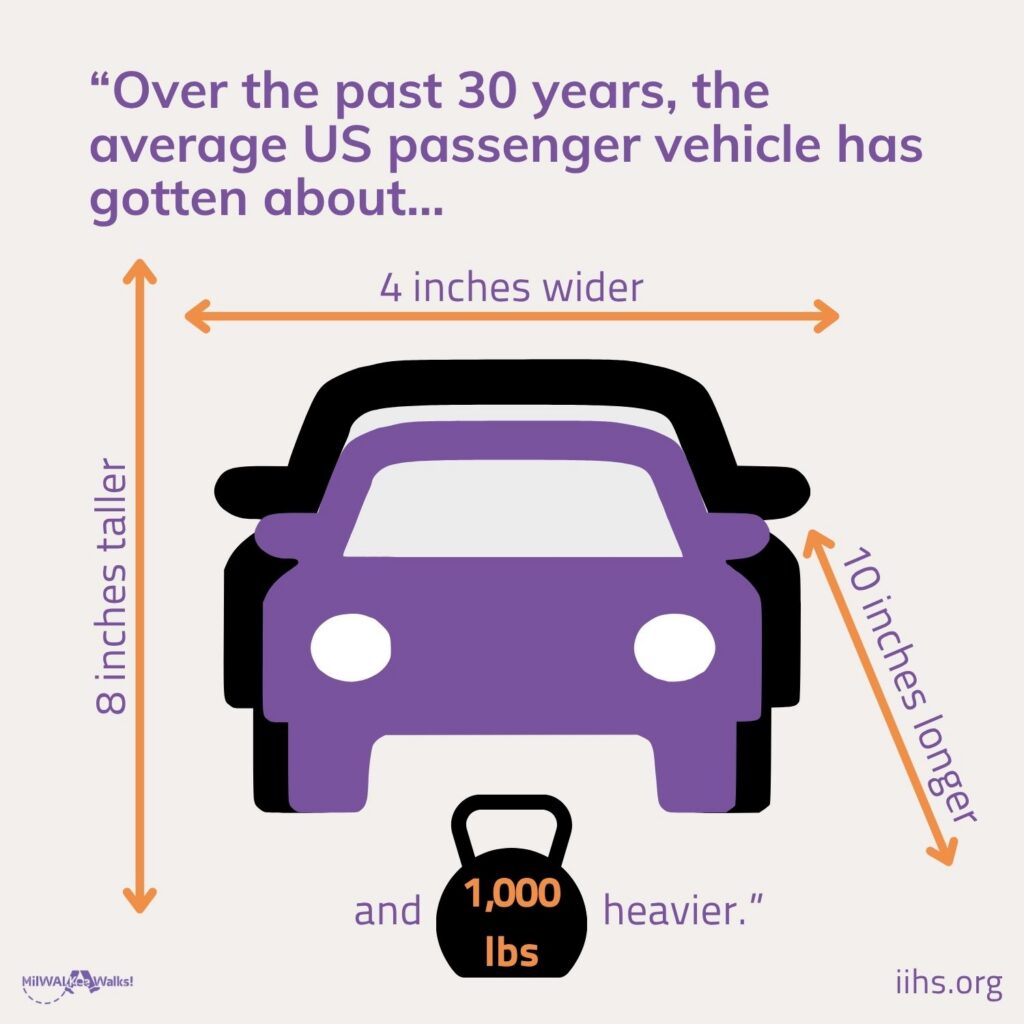
Half of the fatal pedestrian crashes in 2025 involved large vehicles such as an SUV, truck, or bus. Research has shown that taller hood heights and heavier vehicles pose greater risks to nondrivers on impact. As SUV and pickup truck ownership has increased, so has the percentage of pedestrian fatalities attributed to those vehicles. Vehicle safety ratings currently only pertain to the occupants of the vehicle. SUVs are marketed as “safer” because they better protect the occupant. However, little thought is given to people outside of the vehicle. As our nation’s vehicle fleet grows larger and taller, we need to acknowledge the increased risk and design roads that limit and reduce speeds.
8 pedestrian fatalities occurred along the High Injury Network
Half of the fatal pedestrian crashes in 2025 occurred along the High Injury Network. High Injury Networks (HIN) are a mapping tool utilized by cities who are looking to decrease their number of fatal and serious injury crashes. The HIN identifies streets and intersections where there are disproportionately high numbers of serious crashes. The City of Milwaukee has identified a Pedestrian High Injury Network, by looking exclusively at pedestrian data. As part of their Complete Communities Transportation Planning Project, Milwaukee County has looked at all types of crash data to determine their top 25 Corridors of Concern. Unsurprisingly, there is a lot of overlap between the County’s Corridors of Concern and the City’s HIN. We KNOW these street segments are dangerous: without drastic changes, we can continue to expect to see these types of crashes.
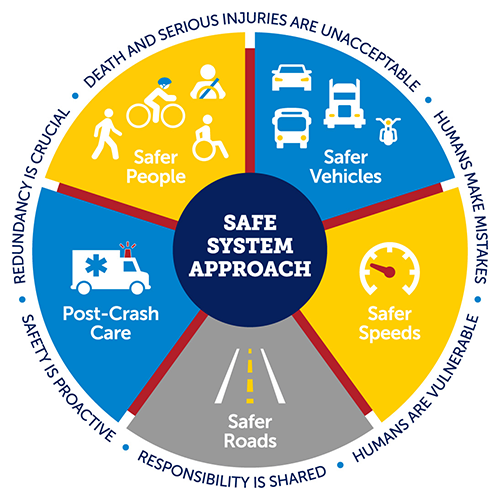
There is no single cause behind these crashes, just a lot of room for human error to claim a life. All of these instances should be examined to understand what could have prevented them. A Safe Systems Approach to traffic safety accepts that humans make mistakes, but that those inevitable mistakes shouldn’t lead to life-altering injury or death. The Safe Systems Approach is all about layering, creating a system of redundancies so that if one mistake happens, there are still safeguards in place.